NBA Betting Glossary for UK Punters
 Available in US

A UK-First Glossary for the Modern NBA Punter
Half the confusion in NBA betting comes from terminology. The sport’s betting language evolved in the United States, where “spread” means one thing, “juice” means another, and “chalk” has nothing to do with chalkboards. UK punters walk into this world with their own vocabulary – handicap, acca, evens, priced up – and the translation between the two systems is not always intuitive. I have spent twelve years operating in both language systems, and this glossary is the reference I wish I had when I started.
The EY-Parthenon Sports Engagement Index for 2025 showed basketball climbing seven positions in UK popularity, reaching 6th place among Gen-Z fans. Simon Mantell, EY’s Sports Industry Sector Lead, highlighted the rapid growth as driven by digital content and live experiences. That growth means a wave of new UK punters are entering NBA betting markets – and they need a translation guide that speaks their language first.
Market Terms: Spread, Handicap, Acca, Bet Builder
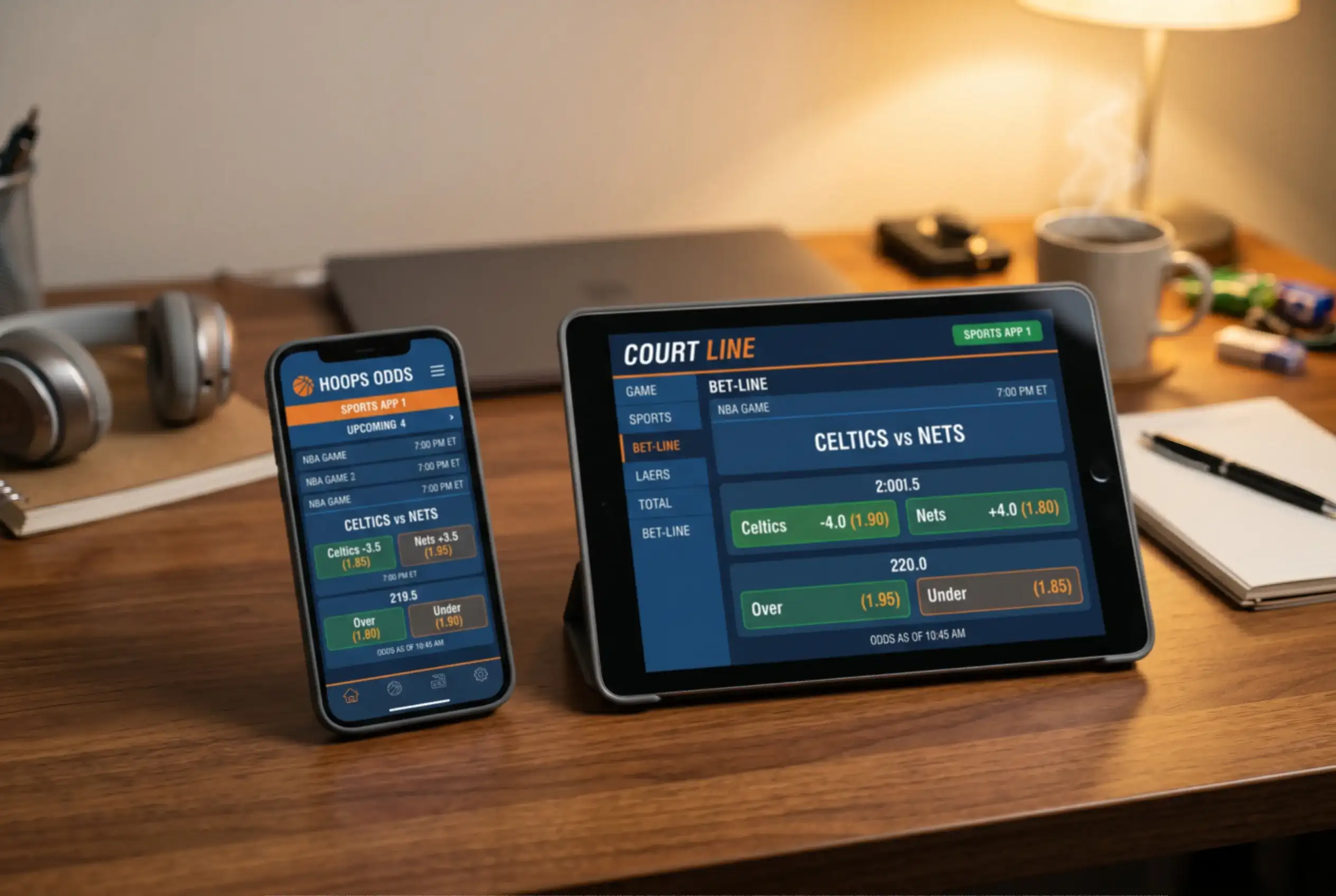
Spread / Handicap: The same concept with different names. In the US, a team is “favoured by 6” or “getting 6 points.” In the UK, the same bet is called a handicap – the favourite gives points, the underdog receives them. A spread of -6.5 at a US book is a handicap of -6.5 at a UK book. The mechanics are identical; only the label changes. When a UK punter hears “the spread is 5,” they should mentally translate to “the handicap line is -5 / +5.”
Moneyline / Outright Winner: Backing a team to win the game without any point adjustment. The US uses “moneyline” and prices in American odds (+150, -200). The UK uses “outright winner” or simply “match winner” and prices in decimal odds (2.50, 1.50). The underlying bet is the same.
Accumulator (Acca) / Parlay: A multi-selection bet where all legs must win for the ticket to cash. The UK calls it an accumulator or acca; the US calls it a parlay. A “same-game parlay” in US terminology is a “bet builder” at most UK sportsbooks – multiple selections from the same game combined into one bet. The average NBA game produces a total around 220-224 points, and accas built on NBA totals tend to carry compounded vig that makes them difficult to beat long-term.
Bet Builder / Same-Game Parlay (SGP): A feature that lets you combine spread, total, and player-prop selections from a single game into one bet. Popularised in the UK market under the “bet builder” branding, it functions identically to the US “same-game parlay.” Correlation adjustments mean the combined odds are not a simple multiplication of the individual legs.
Alternative Lines / Teasers: Adjusted spreads or totals offered at different prices. “Alternative spread” at a UK book is the same concept as “buying or selling points.” A teaser adjusts two or more legs by a fixed number of points in the bettor’s favour – common in US football, less common in UK NBA markets.
Maths Terms: Vig, Implied Probability, EV, CLV
Vig / Juice / Margin / Overround: The bookmaker’s built-in profit margin. In the US, it is called “vig” or “juice.” In the UK, “margin” or “overround” are more common. On a standard NBA spread, the vig is roughly 4.5% – meaning the bookmaker takes 4.5 pence of every pound staked as their fee. A “vig-free” or “no-vig” line strips out this margin to show the true implied probability.
Implied Probability: The probability of an outcome as implied by the decimal odds. The formula is 1 / decimal odds. Odds of 2.00 imply a 50% probability. Odds of 1.50 imply 66.7%. Odds of 3.00 imply 33.3%. When the sum of implied probabilities across all outcomes exceeds 100%, the excess is the bookmaker’s margin.
Expected Value (EV): The average amount you expect to win or lose per bet over the long run. Positive EV (+EV) means the bet is profitable over time; negative EV (-EV) means it is not. The formula is: (probability of winning * profit if win) – (probability of losing * loss if lose). Every bet decision should ultimately answer the question: is this +EV?
Closing Line Value (CLV): Whether you beat the final odds set by the bookmaker before tip-off. If you bet at 2.10 and the line closes at 1.95, you captured positive CLV. Over large samples, consistently positive CLV is the strongest indicator that a bettor is skilled rather than lucky.
Market Behaviour: Steam, RLM, Sharp, Square
Sharp / Square: “Sharp” describes a professional or highly informed bettor whose action the bookmaker respects and adjusts for. “Square” describes a recreational bettor whose action the bookmaker welcomes because it tends to be on the popular side. UK equivalents are less codified, but “mug punter” roughly maps to “square” and “shrewd” or “professional” maps to “sharp.”
Steam Move: A rapid, coordinated line movement driven by sharp action hitting multiple books simultaneously. When you see an NBA spread drop from -5 to -3 at three books within sixty seconds, that is a steam move. The steam indicates that a sharp source has placed large bets across the market at the same time.
Reverse Line Movement (RLM): When the point spread moves in the opposite direction from the public betting percentage. If 70% of bets are on Team A but the line moves toward Team B, the sharp money is on Team B. RLM is one of the most reliable signals of where informed money sits on a given game.
Handle / Ticket: “Handle” is the total money wagered on a market. “Ticket” or “ticket count” is the number of individual bets. The distinction matters because the public places many small bets (high ticket count) while sharps place fewer large bets (high handle, low ticket count). A divergence between ticket percentage and handle percentage signals disagreement between the public and the sharps.
NBA-Specific: Pace, eFG%, Four Factors, B2B
Pace: The number of possessions a team uses per 48 minutes. Pace is the most important number for totals betting because it determines how many scoring opportunities the game will produce. Two fast-paced teams create more possessions and, typically, more points.
Effective Field Goal Percentage (eFG%): A shooting metric that adjusts for the extra value of three-point shots. The formula: (FG + 0.5 * 3PM) / FGA. eFG% is a better predictor of offensive quality than raw field goal percentage and carries the highest weighting in Dean Oliver’s Four Factors framework.
Four Factors: Dean Oliver’s framework that explains approximately 90% of the variance in NBA winning and losing. The four factors are: effective field goal percentage, turnover percentage, offensive rebound rate, and free throw rate. Together they provide a more complete picture of team quality than traditional box-score stats.
Back-to-Back (B2B): When a team plays on consecutive calendar days. Teams on the second night of a B2B win roughly 43.6% of their games against rested opponents and lose about 2.21 points per 100 possessions in net efficiency. The B2B penalty is one of the most persistent scheduling edges in NBA advanced betting maths.
Load Management: A team’s decision to rest a healthy player to preserve his body for more important games. The NBA’s Player Participation Policy limits rest on nationally televised games, but coaches still rest stars on adjacent low-profile dates – creating line-movement opportunities for bettors who track the pattern.
Player Prop: A bet on an individual player’s statistical performance rather than the game outcome. Points, rebounds, assists, three-pointers made, and combinations thereof are the most common NBA player-prop markets. The 2025 integrity investigations involving Terry Rozier and others have reshaped the prop landscape, with under-props on low-minute players largely removed from UK books.
Why is ‘spread’ called ‘handicap’ in the UK?
The terms describe the same concept from different perspectives. ‘Spread’ emphasises the numerical gap between the teams. ‘Handicap’ emphasises the adjustment applied to equalise the contest. UK sportsbooks adopted ‘handicap’ from horse racing and football traditions, while ‘spread’ became standard in US sports betting.
What does ‘priced up’ mean on early NBA markets?
‘Priced up’ means the bookmaker has published their odds for a game. When a UK sportsbook ‘prices up’ the NBA schedule, they have set opening lines on the spreads, totals, and moneylines. Early pricing typically appears 18-20 hours before tip-off and represents the book’s initial assessment before sharp action adjusts the numbers.
Are ‘evens’ and 2.00 the same thing?
Yes. ‘Evens’ is the UK term for odds that return exactly double your stake – a one-pound bet returns two pounds (one pound profit). In decimal notation, this is 2.00. In American odds, it is +100. All three expressions describe a 50% implied probability before margin.
Prepared by the Best nba Betting Strategy editorial staff.