NBA Point Spread Strategy for the Late Regular Season
 Available in US
What a Spread Is Really Pricing In
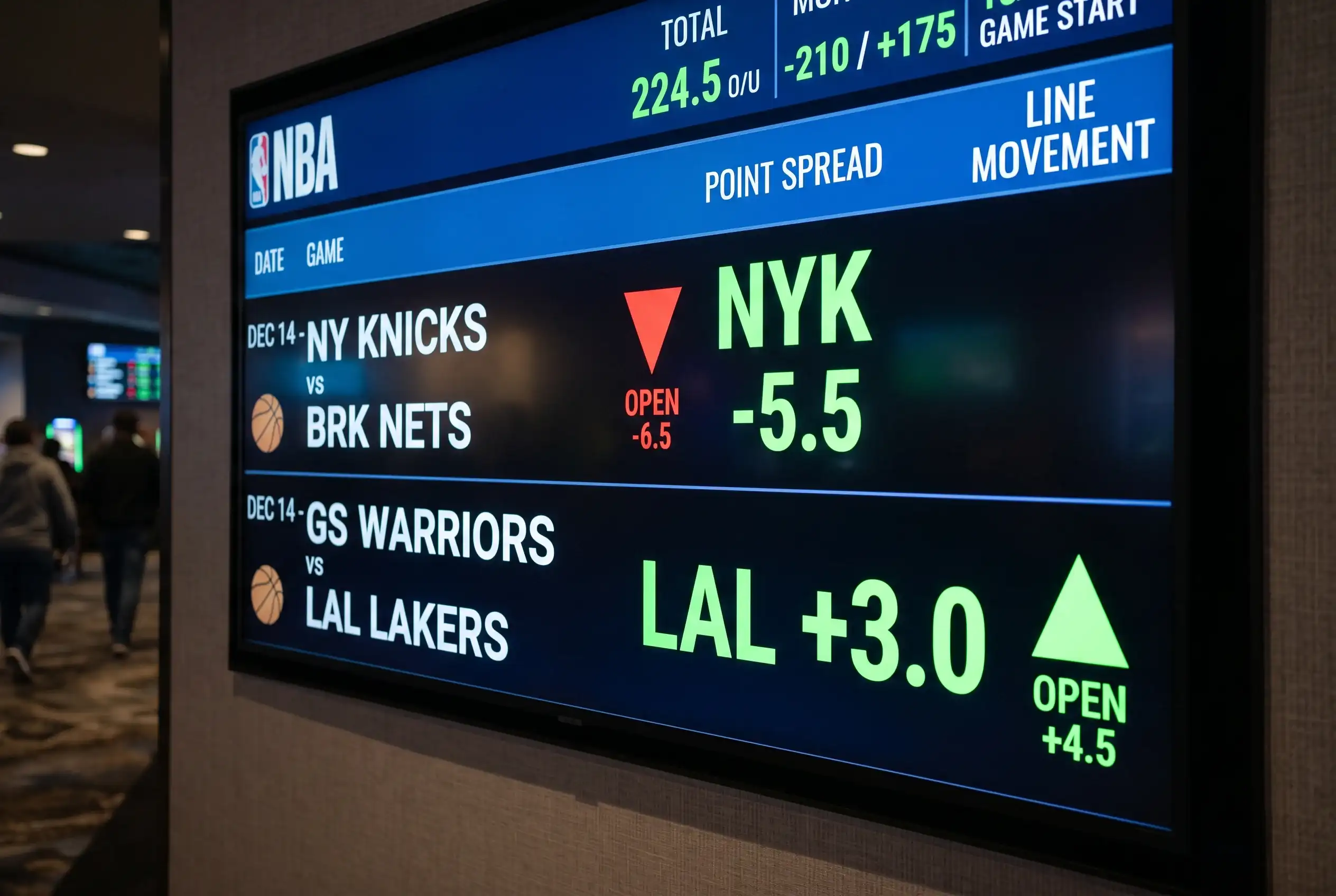
Every NBA spread is an opinion disguised as a number. When a bookmaker posts Boston -6.5 against Chicago, they are not predicting the final margin, they are setting a number that splits the betting public roughly in half. Understanding that distinction changed the way I approach spreads entirely, because it means the number is not always right. It just needs to attract balanced action.
A point spread in UK books is called a handicap. The mechanics are identical: the favourite has points deducted from their final score, the underdog has points added, and you are betting on which adjusted total is higher. At 1.91 on both sides, you need to win 52.4% of your bets to break even after the bookmaker’s margin. That 2.4% gap between 50% and breakeven is the entire game, your edge has to live inside it.
The spread also bakes in every piece of public information available at the time of posting: team records, injuries, home court, rest, recent form. What it does not always price correctly is the interaction between those factors. A team might be 8-2 in their last ten, but five of those wins came against bottom-five defences on home court. The spread reflects the 8-2 record; it may not reflect the quality of competition behind it. That gap between what the spread says and what the data says is where your edge lives.
The Key Numbers in NBA Spreads (and Why They Matter Less Than NFL)
If you have bet American football, you know that 3 and 7 are sacred numbers, games cluster around those margins because of the scoring structure. NBA spreads work differently. Basketball scoring is continuous (one point from free throws, two from the field, three from beyond the arc), so final margins distribute more evenly. There is no single key number in the NBA the way 3 dominates NFL.
That said, some margins appear slightly more often than others. Finals margins of 1-5 points are relatively common because close games stay close, and margins of 7-12 points reflect comfortable but not dominant wins. The Boston Celtics posted a +4.10 average point differential at home across three recent seasons, per the RotoWire Home Court Advantage Index, a number that tells you a spread of -4 or -5 is the market’s natural resting place for a strong home side against an average opponent.
The practical takeaway: do not pay a premium to buy through a specific number in NBA the way you would in NFL. If a book offers you Boston -5.5 and another has -5, the half-point matters, but not because 5 is a key number. It matters because any half-point of margin, compounded over a hundred bets, shifts your long-term outcome by a meaningful amount. Line shopping matters here not for key-number reasons but for volume reasons.
How Spread Strategy Shifts From October to April
I think of the NBA regular season in three phases, and each one demands a different spread approach.
October through November is the calibration phase. Teams are integrating new players, experimenting with rotations, and shaking off preseason rust. The market is still anchored to last season’s expectations and offseason narratives. This is where contrarian spread bets carry the most value, backing a team the public has written off after a slow start, or fading a hyped roster that has not gelled. The data is thin, which means the models driving bookmaker lines are running on smaller samples, and samples under 15 games are unreliable for predicting anything.
December through February is the grind phase. Rotations stabilise, pace numbers become reliable, and the spread market tightens. Edges here come from situational awareness rather than narrative plays. Back-to-back situations, road trip length, and injury-report reads become the primary tools. Teams on the second night of a back-to-back win at roughly 43.6%, which means the spread adjustment the market applies, typically 1.5 to 2.5 points, is not always enough, especially when the rested opponent has a strong home-court record.
March through mid-April is the motivation phase, and this is where spread strategy gets truly interesting. Playoff-locked teams begin resting starters. Tanking teams have no incentive to compete. Play-in teams are desperate. The spread market struggles with motivation because it is not quantifiable the way pace or efficiency is. When a top seed rests two starters for a late-March road game, the line might move 3 points – but the actual impact of missing those players on team chemistry, bench depth, and in-game adjustments can be larger or smaller than 3 points depending on the specific roster construction.
Revenge Spots and Look-Ahead Games
Revenge games are one of the most overrated narratives in NBA betting. The idea that a team will play harder because they lost to this opponent two weeks ago sounds compelling, but it rarely shows up in the data with any statistical significance. Professional athletes play 82 regular-season games – they do not carry grudges from a random Tuesday in January into a Thursday in February.
Look-ahead spots, however, are genuinely useful. A look-ahead game is one where a team plays a weaker opponent the night before facing a marquee rival. The risk is that the team – consciously or not – conserves energy for the bigger game. Coaches may shorten rotations or reduce star minutes. The spread on the look-ahead game often does not fully account for this, because the market prices what should happen based on talent rather than what will happen based on context.
I have found the most reliable look-ahead spots share three features: the team is on a road trip (so there is travel fatigue layered on top of the motivational gap), the next game is against a division rival or a top-four seed, and the look-ahead game is against a team outside the playoff picture. When all three align, fading the favourite on the spread is a play I return to regularly.
Buying and Selling Points in UK Books
Some UK bookmakers let you adjust the spread in exchange for different odds. Moving a -5.5 to a -4.5 might shift the price from 1.91 to 1.75. Moving it the other way to -6.5 might push it to 2.10. The question is whether the adjustment is worth the price change.
In most cases, buying a single point in NBA is not worth the cost. Because final margins distribute relatively evenly (unlike NFL, where buying through 3 is enormously valuable), the probability gain from one point of spread adjustment is roughly 2-3%. If you are paying 0.16 in reduced odds for that 2-3% probability gain, the maths rarely works in your favour over a large sample.
Selling points – taking a worse spread for better odds – can occasionally make sense when you have a strong conviction about a blowout. If you believe a team will win by double digits, selling from -5.5 to -7.5 at an improved price captures that conviction. But this is a high-confidence play, not a default strategy. The way the line itself moves between open and close often tells you more about the right side than any point-buying exercise.
The broader discipline with NBA spreads is restraint. You do not need to bet every game. The late regular season offers a concentrated window of exploitable situations – back-to-backs, rest games, motivation gaps, look-ahead spots – and the punters who profit are the ones who wait for those spots rather than forcing action on a random Wednesday night card.
Are NBA key numbers as important as NFL key numbers?
No. NFL scoring clusters around margins of 3 and 7 due to the touchdown-and-field-goal structure, making those numbers critical for spread bettors. NBA scoring is continuous, so final margins distribute more evenly. No single number carries the outsized importance that 3 does in American football, though any half-point of spread still matters over a large sample of bets.
When should I lay -7 instead of taking -3.5?
Taking a larger spread at better odds only makes sense when you have strong evidence of a blowout scenario – for example, a top-five home team against a bottom-five road team on the second night of a back-to-back. Without that specific conviction, the tighter spread at standard juice is the safer long-term play because NBA games are more volatile than the public assumes.
What is a look-ahead spread?
A look-ahead spread refers to a game where one team faces a weaker opponent immediately before a marquee matchup. The idea is that the team may conserve energy or shorten rotations ahead of the bigger game, creating value on the underdog side of the spread in the look-ahead contest.
Prepared by the Best nba Betting Strategy editorial staff.