NBA Live (In-Play) Betting Strategy for UK Time Zones
 Available in US
Why UK Time Zones Are an In-Play Advantage
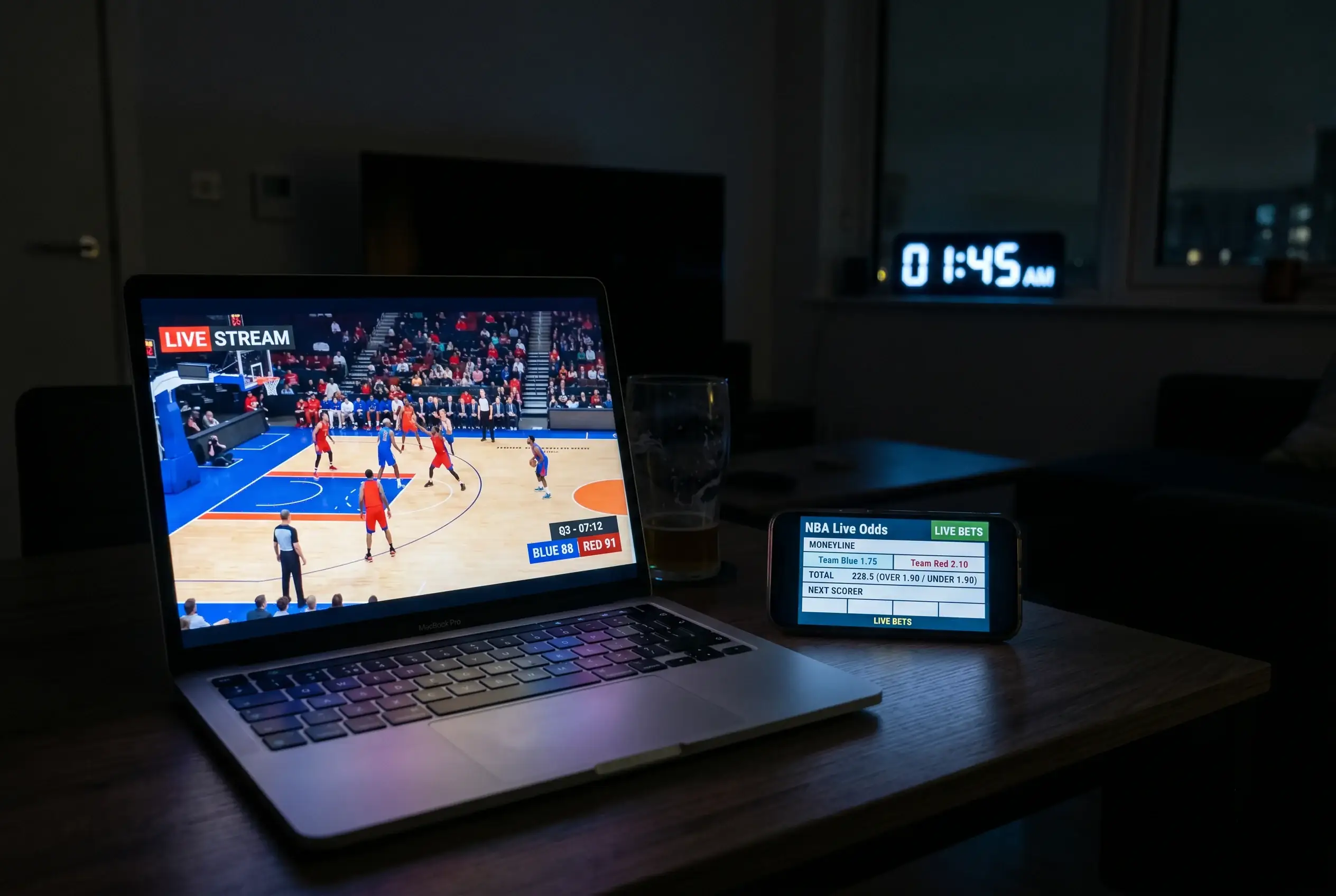
Most NBA games tip off between 00:00 and 03:30 GMT on a weeknight. That sounds like a disadvantage, and for pre-game bettors, it is. But for in-play bettors, the UK time zone creates a surprisingly useful filter. You are only awake for these games if you have chosen to be. The casual punter who impulse-bets during a lunch break does not exist at 1 AM on a Tuesday. The market at that hour is thinner, the recreational money is asleep, and the pricing algorithms are doing most of the work without the noise of public sentiment.
Sky Sports viewership of NBA in the UK has grown roughly 40% since 2019, with the sharpest increase among viewers under 30. That audience growth has brought more UK punters into NBA in-play markets, but the late-night scheduling still acts as a natural selection mechanism. The people betting in-play at 2 AM tend to be more engaged and more analytical than the average Saturday afternoon football bettor, which means the edges are harder to find but more sustainable when you do find them.
Quarter-by-Quarter Live Betting Patterns
NBA games have a rhythmic structure that in-play bettors can exploit. The first quarter is typically the tightest, with both teams running their primary offensive sets and coaches making minimal adjustments. The live spread at the end of Q1 often overreacts to whichever team happened to shoot better from three in those opening twelve minutes.
The second quarter brings bench rotations, which introduces volatility. Teams with deep benches maintain or extend leads; teams with thin rotations often give back first-quarter advantages. If you have studied rotation patterns (and you should, they are published data), Q2 is where mismatches between starting-unit quality and bench-unit quality create live spread value.
Halftime is the reset point. The live spread at halftime tends to be the most accurate of the game because it incorporates a full half of data and a natural pause that reduces the algorithm’s reliance on momentum. Betting immediately after halftime, before Q3 scoring creates new momentum signals, is often less valuable than waiting for the first five minutes of Q3 to see how coaching adjustments have landed.
The fourth quarter is where in-play markets get wild. Intentional fouling in close games, garbage-time scoring in blowouts, and strategic timeouts all create rapid line movement that the algorithm prices reactively. The opportunity here is in recognising when the live spread has overadjusted to a run that will not sustain, a 10-0 burst in two minutes might move the live spread three points, but if the run was fuelled by transition baskets off turnovers and the trailing team’s coach just called a timeout, regression is likely.
Run-Based Overreaction Windows
Every NBA game contains scoring runs. A 12-2 run in the third quarter is not unusual – it happens in the majority of games. The live betting algorithm responds to these runs by shifting the spread in favour of the team on the run, often by 2-4 points within minutes. The question is whether the run reflects a genuine shift in game dynamics or a temporary burst that will revert.
Runs driven by defensive intensity – forced turnovers leading to fast breaks, increased defensive rebounding, tighter perimeter contests – tend to be more sustainable than runs driven by offensive hot streaks. A team hitting five consecutive three-pointers is generating a run, but three-point shooting is one of the most variable statistics in basketball. The probability of the next five possessions producing another five threes is minimal. If the live spread has moved 3 points based on a shooting burst, fading that movement is often the right play.
Conversely, runs driven by a coaching adjustment – switching to a zone defence that the opponent has not prepared for, or inserting a defensive specialist who changes the matchup – tend to hold longer because the adjustment persists until the opposing coach counters it. Reading the cause of the run, not just its magnitude, is the core skill of in-play NBA betting.
Streaming, Latency and How To Beat the Algo
You cannot bet in-play NBA effectively without watching the game. The live spread algorithm processes box-score data – points, turnovers, fouls – within seconds of each event. What it does not process is visual information: body language, fatigue, a player favouring an ankle, a coach’s frustration with his bench unit. That visual layer is your edge over the algorithm, and it requires a live stream.
UK-based streaming through licensed operators typically runs 3-8 seconds behind the real-time broadcast. That latency gap means you are seeing events after the algorithm has already priced them. To work around this, do not bet reactively (trying to get a bet in after seeing something happen). Instead, bet proactively: watch patterns develop over several minutes, form a view on the next 3-5 minutes of play, and place your bet before the event that confirms your thesis.
Teams on the second night of a back-to-back lose about 2.21 points per 100 possessions in net efficiency. That fatigue compounds as the game progresses – the fourth quarter of a back-to-back game sees the largest efficiency decline. If you are watching a fatigued team maintain a lead through three quarters, the live market may not fully price the expected fourth-quarter fade. That is a proactive in-play thesis, not a reactive one.
Live Totals: Pace Adjustments After Q1
Live totals are my favourite in-play market because they are the most predictable. After the first quarter, you have 25% of the game’s data – enough to estimate the real pace of the specific game (not the season-average pace of each team, but how this particular matchup is flowing). If Q1 combined scoring is 58 and the pre-game total was 224, the implied pace for the full game is 232. The live total at that point might sit at 228-230, reflecting some regression but not full regression to the pre-game line.
The edge comes from knowing when Q1 pace is sustainable. If the high scoring came from fast-break points off turnovers by a team that does not normally turn the ball over at that rate, the pace will regress. If it came from both teams playing at their natural tempos and simply shooting well, the pace is more likely to hold. Separating pace-driven scoring (sustainable) from efficiency-driven scoring (mean-reverting) is the key skill in context factors that hold during live action.
One last practical note for UK punters: the best live betting windows are the 00:30-01:30 GMT slot (east-coast games in their second half) and the 04:00-05:00 GMT slot (west-coast games approaching the fourth quarter). If you are going to stay up, pick one window and commit to it rather than trying to cover the entire slate. Sleep is a bankroll management tool that too many late-night bettors ignore.
What is a typical latency gap between feed and bookmaker?
UK-based live streams typically run 3-8 seconds behind the real-time broadcast. The bookmaker’s algorithm processes scoring data within 1-2 seconds of the event, so by the time you see a basket on your stream, the live odds have already moved. This makes reactive betting impractical and proactive thesis-driven betting essential.
Are NBA live spreads tighter than pre-game spreads?
Live spreads reflect the current game state and tend to be more accurate than pre-game lines because they incorporate actual performance data. The margin on live bets is typically slightly higher than pre-game to compensate the bookmaker for the increased information disadvantage, but the efficiency of the live market means the spread itself is a better reflection of true probability.
Is in-play betting realistic during late-night UK hours?
It depends on your lifestyle. East-coast NBA games reach their second halves between 00:30 and 01:30 GMT, which is manageable for many adults. West-coast games do not reach the fourth quarter until 04:00-05:00 GMT. Picking one time window per session and focusing on that slate is more sustainable than trying to cover every game.
Published by the Best nba Betting Strategy team.