NBA Bet Types Explained: A UK Punter’s Guide to Markets, Builders and Accumulators
 Available in US

Table of Contents
- Why NBA Markets Reward Specialists, Not Generalists
- Moneyline: When Picking the Winner Actually Pays
- Point Spread (Handicap) Mechanics in UK Books
- Over/Under Totals: Pace, Style and Garbage-Time Effects
- Player Props: What’s Bookable in 2025-26
- Bet Builder: Same-Game Combinations Without the Vig Trap
- Accumulators (Accas) and the Correlation Problem
- Futures and Outrights: The Long-View Markets
- Alternative Lines and Teasers: Adjusting the Number
- Frequently Asked Questions
Why NBA Markets Reward Specialists, Not Generalists
I spent my first two years betting on the NBA the way most UK punters do: I backed the team I fancied, took a spread if the price felt right, and occasionally lobbed a tenner on a five-leg acca because the potential return looked gorgeous on the betslip. My results were exactly what you would expect from someone who treated nine distinct markets as one big lucky dip: I lost slowly, consistently, and without ever understanding why.
The turning point was narrowing down. NBA betting at a UKGC-licensed book in 2026 offers more market depth than any other North American sport: moneyline, point spread (what UK books call “handicap”), totals, player props, bet builders, accumulators, futures, alternative lines and teasers. That is not a buffet you want to graze at random. The average match carries a total somewhere around 220-224 points, per Covers.com matchup data, and every market slices that combined score from a different angle. Each angle has its own logic, its own edges and its own traps.
What I have learned across twelve years of line-watching is that specialists beat generalists in this sport. The punter who understands how pace-adjusted efficiency shapes a total line will outperform the one who spreads bets across six markets per night. This guide walks through each NBA bet type available at UK sportsbooks, explains its mechanics honestly, and flags the situations where each market either rewards or punishes you.
Moneyline: When Picking the Winner Actually Pays
A moneyline bet strips the game to its simplest form: pick which team wins, no spread attached. At UK books the price appears in decimal format (Boston Celtics 1.35, opponent 3.20) and your return is stake multiplied by odds. Clean, transparent, and deceptively difficult to profit from over a full season.
The trap sits at the short end. When you back a heavy favourite at 1.20, you need that team to win 83% of the time just to break even. The Celtics posted a home win rate of 0.751 across three seasons at TD Garden, according to RotoWire’s Home Court Advantage Index, dominant but nowhere near 83%. Lay -350 on a team that wins 75% of the time and you are bleeding units, no matter how safe each individual bet feels. I have watched punters chain four such “certainties” into an acca and lose their week’s bankroll on a single upset. The maths does not care about your confidence level.
Where moneyline genuinely pays is on underdogs. A +200 dog only needs to win 33.3% of the time to show long-term profit, and in an 82-game regular season there are dozens of spots where a rested underdog at home against a fatigued road favourite clears that threshold comfortably. The key is selectivity: not every dog is a value dog, and the price has to exceed the team’s real win probability in that specific context.
I use moneyline almost exclusively on dogs priced between +150 and +300 where a contextual edge – rest, travel, injury – gives me reason to believe the true probability is higher than the market implies. On favourites, I nearly always prefer taking the spread instead. The margin of safety is wider, and the juice is kinder.
Point Spread (Handicap) Mechanics in UK Books
If you have bet on football in the UK, you already understand Asian handicaps. NBA point spreads work identically: the bookmaker assigns a number to level the playing field, and you bet on whether the favourite wins by more than that number or the underdog keeps the margin within it. At UK books this market is labelled “handicap” rather than “spread”, but the mechanics are the same.
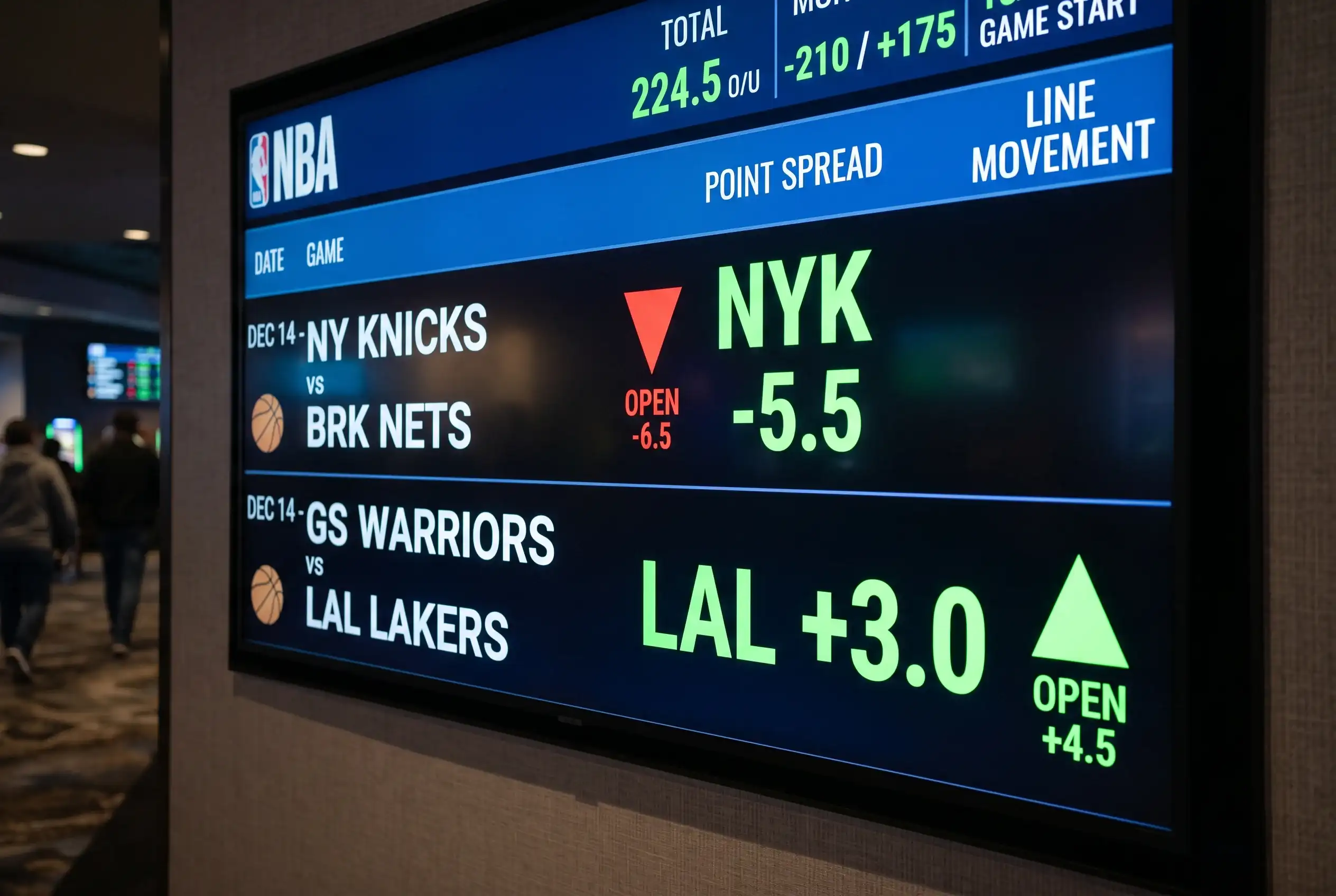
A typical NBA spread looks like this: Boston Celtics -6.5 at 1.91, Sacramento Kings +6.5 at 1.91. If you back the Celtics, they must win by seven or more. Back the Kings, and they can lose by six and you still collect. The half-point eliminates ties, because there is no push on a 0.5 line, which is why UK books love it.
Spreads are the bread-and-butter market for serious NBA bettors because they neutralise the favourite-dog imbalance that makes moneyline pricing so lopsided. Both sides typically sit near 1.91, meaning you are paying roughly equal juice (the bookmaker’s margin) regardless of which team you take. That symmetry makes the spread the purest test of your read on the game.
The number itself reflects a blend of power ratings, public perception, and situational factors. Home court advantage built into the line ranges from about 1.5 to 4 points depending on the franchise. RotoWire’s three-season data shows that certain arenas, notably Boston’s TD Garden and Denver’s Ball Arena, consistently produce a home-side differential above the league average. Understanding how much home court is already baked into the spread stops you from over-valuing it.
One UK-specific detail worth noting: some books offer alternative spreads (covered later in this guide), but the standard line at -110 equivalent pricing (1.91 decimal) is where the market is sharpest. If you are new to NBA handicap betting, start here before exploring exotic numbers.
Over/Under Totals: Pace, Style and Garbage-Time Effects
Somewhere around the third month of my NBA betting career I realised I had no edge picking winners but could read pace matchups reasonably well. That is when I moved to totals (the over/under on combined points scored) and my results improved almost overnight.
The bookmaker posts a number, say 224.5, and you bet on whether the two teams combined will score more or fewer points. The average NBA game in 2025-26 lands around 220-224 combined points, per Covers.com matchup references, but that average disguises enormous variance. A clash between two top-five-pace teams can blow past 240. A grinding defensive matchup between playoff-calibre squads might stall below 210.
Pace – the number of possessions per 48 minutes – is the single most important variable for totals bettors. More possessions mean more shot attempts, more free throws, more points. When a team that averages 101 possessions per game meets one that averages 96, the matchup pace will not simply be 98.5; it depends on who controls tempo, rebounding pace, and turnover rates. That non-linear interaction is exactly where edges hide.
Garbage time is the other factor most casual punters ignore. In blowouts, benches empty in the fourth quarter and the pace changes unpredictably. Sometimes bench units score freely against soft defences, pushing a game over a total that the starters’ performance would have held under. Sometimes they grind the clock down and the scoring dies. If you are betting on totals from a pure pace model, garbage-time variance will inflate your error bars, which is one reason I prefer first-half totals for cleaner signal, a topic covered in the advanced betting maths behind fair pricing.
Player Props: What’s Bookable in 2025-26
Player props let you bet on individual statistical lines (points, rebounds, assists, threes, steals, blocks, or combinations) rather than the team result. It is the fastest-growing NBA market in the UK, and as of the 2025-26 season, it is also the most disrupted.
In October 2025, the FBI arrested Terry Rozier, former player Damon Jones, and Portland head coach Chauncey Billups on charges related to illegal betting activity, per federal indictment coverage from Yahoo Sports and Front Office Sports. Rozier posted a £3 million bail. This followed the Jontay Porter case in 2024, which led the NBA to ask its sportsbook partners to remove under-prop bets on players with two-way contracts, per SBC Americas reporting.
What does that mean for UK punters right now? Several categories of player prop have been quietly pulled or tightened. Under-props on fringe roster players are harder to find at UKGC-licensed books than they were eighteen months ago. Some operators have reduced maximum stakes on player unders across the board. The market that remains is tilted toward over-props on established starters, and toward points and assists rather than the rebounds and blocks that are easier to manipulate.
If you bet player props, focus on usage rate and minutes projection as your two core inputs. A player who commands 30% of his team’s possessions while on court and plays 36 minutes a night has a far more predictable stat line than a rotation player logging 18 minutes with inconsistent usage. The integrity reforms have actually made the remaining prop markets slightly more reliable for analytical bettors – fewer fringe-player traps, sharper lines on star output. Adam Silver himself noted that with the current regulated structure of legalised betting, the league can monitor aberrational behaviour in ways that were impossible before, per his October 2025 appearance on the Pat McAfee Show.
Bet Builder: Same-Game Combinations Without the Vig Trap
Bet builders – called same-game parlays in the US – let you combine multiple selections from a single NBA game into one bet. Back the Celtics spread, the under on total points, and Jayson Tatum over 27.5 points, all on a single slip, with the odds multiplied together. UK books have made this the centrepiece of their NBA marketing, and I understand why: the potential returns look spectacular.
The problem is correlation, or more precisely, the way books handle it. In a truly independent parlay, the odds of each leg are multiplied cleanly because the outcomes do not affect each other. But in a same-game builder, the legs are correlated. If you back the under on the total, a blowout is more likely – and blowouts reduce star minutes, which pushes a player’s points prop under too. The bookmaker knows this. The adjustment they apply to correlated legs means you are rarely getting fair value on the combination, even when the individual prices look reasonable.
That does not mean bet builders are never worth touching. They work best when you build around legs that are genuinely low-correlation: a team spread combined with a player from the opposing team to hit a rebounds line, for example. Keep the leg count to two or three. Every leg you add multiplies the vig you are paying, and by four or five legs the cumulative margin often exceeds 20%. I have seen builders priced at 8.00 that, when you strip out the vig on each leg, should be closer to 12.00. The difference is the book’s edge, and it compounds fast.
If you enjoy builders as entertainment, set a separate, small bankroll for them and treat the stake as gone. If you are trying to build long-term yield, stick to single bets or two-leg builders where you have a genuine read on the correlation.
Accumulators (Accas) and the Correlation Problem
Accumulators – accas – are the UK punter’s comfort food. String four or five NBA moneyline favourites together, watch the potential return climb into triple digits, and hope the universe cooperates. I did this religiously for my first year. The universe did not cooperate.
The maths is unforgiving. Each leg in an acca carries the bookmaker’s margin, typically 4-5% on a standard NBA spread or moneyline. On a single bet, that margin is manageable. On a four-leg acca, the margins compound: you are effectively paying somewhere around 16-20% in cumulative vig, depending on the book and the specific lines. That is a massive headwind before you even consider whether your picks are any good. To put it another way, a four-leg acca needs to win roughly 20% more often than fair odds imply just to break even against the vig.
There is a narrow path to making accas work. Correlated accas – where the legs logically support each other – can offset some of the vig penalty. If you back a team with a strong defensive identity on the spread and pair it with the under on the total, those two outcomes are positively correlated: a team that covers via defence is likely to keep the total low as well. The book adjusts for this in bet builders, but in a traditional multi-match acca across different games, the legs are treated as independent. Finding genuine cross-game correlations is harder, but it is where the edge lives.
Acca insurance promotions – where a book refunds your stake as a free bet if one leg lets you down – can tilt the expected value in your favour on small accas. The key word is “can”. The refund is a free bet, not cash, so its real value is roughly 70% of face value. Run the numbers before assuming the promo makes a five-leg acca profitable. I keep a separate column in my tracking spreadsheet for insurance-eligible accas, and over a season the promotions cover maybe half of what the compounded vig takes from me. Still a net negative, just a smaller one.
Futures and Outrights: The Long-View Markets
Every October, UK books post odds on which team will win the NBA Championship, who will take the MVP award, and a handful of other season-long outcomes. These are futures markets, and they come with a trade-off that casual punters rarely calculate: your money is locked up for months.
A Championship future placed in October will not settle until mid-June. If you stake 100 pounds on a team at 12.00 in October and their odds shorten to 5.00 by February, you have unrealised profit sitting in a bookmaker’s account earning nothing while you could have deployed that capital on dozens of individual game bets with much faster turnover. The opportunity cost of tied-up capital is the hidden fee on every futures bet, and it is almost never reflected in the headline price. Year after year I have seen punters tie up 30% of their bankroll in futures by December, leaving themselves short for the daily grind where edges are more frequent and more measurable.
That said, futures can offer genuine value at specific windows. Pre-season prices are set before training camp, before the first injury report, before we know which teams have real chemistry. If your read on a contender’s depth is ahead of the market, the pre-season number will be the softest you see all year. The other soft window is immediately after the trade deadline, when the market overreacts to blockbuster deals and underreacts to the quieter moves that actually shift playoff rotations.
MVP and award futures are a different beast. The voting pool is small, the narratives that drive it are predictable, and the market moves slowly enough that early-mover advantage is real. If you backed the eventual MVP at 15.00 in October and the price compresses to 3.00 by March, you can hedge by laying the same player at a shorter price to lock in profit regardless of outcome.
Alternative Lines and Teasers: Adjusting the Number
Most UK books now offer alternative lines on NBA games – adjusted spreads and totals at modified prices. Instead of taking the Celtics at -6.5 (1.91), you can buy them down to -3.5 at 1.55 or stretch them to -9.5 at 2.40. The same applies to totals: an over/under of 224.5 can be shifted up or down in increments.
Teasers formalise this by letting you adjust the spread by a fixed number of points across multiple games. A six-point NBA teaser moves your line from -7.5 to -1.5 on one game and from +2.5 to +8.5 on another, at reduced odds. The catch is that NBA teasers are rarely as valuable as NFL teasers because basketball does not have the same clustering of results around key numbers. In the NFL, crossing through 3 and 7 with a teaser has a quantifiable edge. In the NBA, margins of victory are more evenly distributed, so moving through 6 or 7 gives you less structural advantage.
Alternative lines are useful when your read on a game has a specific shape. If you believe the Celtics win comfortably but the standard spread feels too tight at -6.5, buying up to -9.5 at better odds might reflect your conviction better than the default line. The risk is that you are paying for precision – and in a sport with an average margin of victory around 9-10 points, that precision costs more than it looks.
My rule is simple: if I am adjusting the line, it should be because my analysis points to a specific margin range, not because I want a cheaper price for safety. Buying points for comfort is a losing habit across an 82-game grind.
Frequently Asked Questions
What is the difference between a same-game parlay and a bet builder in UK sportsbooks?
They are functionally identical – a single bet combining multiple selections from one game. ‘Bet builder’ is the term UK books use; ‘same-game parlay’ is the US equivalent. The pricing engine behind both adjusts for correlation between legs, so the combined odds will be lower than if you multiplied each leg’s price independently. Some UK operators brand their version differently, but the mechanics and the margin structure are the same.
Are NBA player under-props still available after the Jontay Porter and Rozier cases?
On established starters, yes – most UKGC-licensed books still offer under-props on points, rebounds and assists for players on standard contracts. The market that has shrunk is under-props on fringe roster players, especially those on two-way deals. Several UK operators have also reduced maximum stakes on all player unders. If you are specifically looking for under-props on role players, expect tighter availability and lower limits than two seasons ago.
When does an NBA teaser actually offer a positive expected value?
Rarely. Unlike NFL teasers, where crossing through the key numbers 3 and 7 provides a structural edge, NBA margins of victory are more evenly distributed, so buying six points does not capture the same clustering effect. An NBA teaser can be marginally positive if you are teasing through zero – turning a small favourite into a dog who just needs to not lose – but even then the reduced odds usually absorb most of the advantage. For most UK punters, single bets on the standard spread will outperform teasers over a full season.
Created by the ”Best nba Betting Strategy” editorial team.